 Mainframe Tutorial
 JCL Tutorial
 Introduction
 Mainframe Interview Q&A
 Mainframe Quiz
 Mainframe Memes
 Contact us
 About us
Module 7: DB2 Tables and Tablespaces
 Backward

Tablespace Types
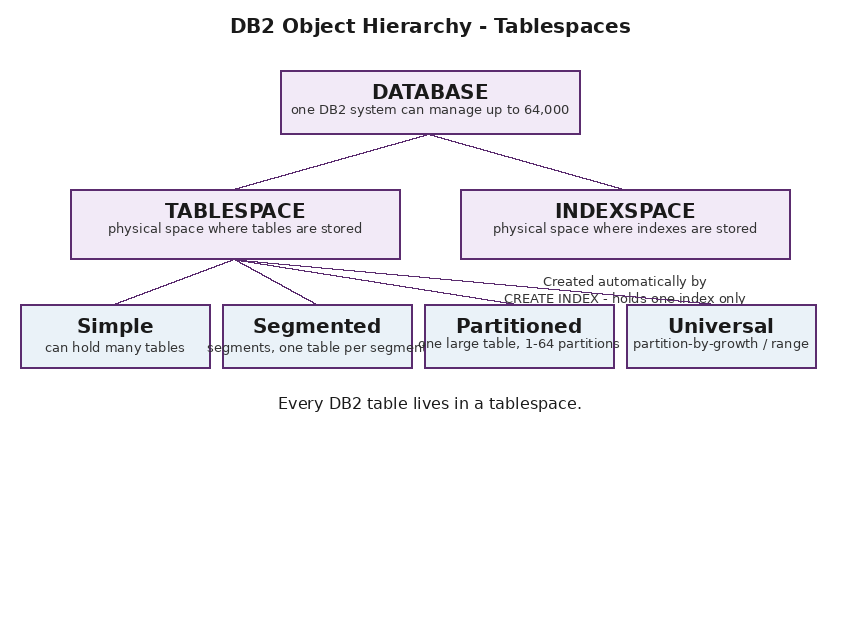
DB2 has four types of tablespaces. The type decides how many tables it can hold and how the space is organized.
Simple tablespace
- Simple is the default type. One simple tablespace can store more than one table.
- Rows of different tables are mixed together on the same pages.
- Depending on the application, storing more than one table might enable faster retrieval for joins using these tables.
- Consider it for highly related tables, where table rows are inserted and deleted together and accessed together.
Segmented tablespace
- The tablespace is divided into equal segments. Each segment can hold only one table.
- A segment consists of a logically contiguous set of n pages, where n is from 4 to 64.
- The SEGSIZE parameter decides the allocation size for the tablespace. No segment is allowed to contain records for more than one table.
- Segmented tablespaces are ideal for storing more than one table, especially relatively small tables.
- Sequential access and mass delete of a particular table are more efficient, because DB2 can drop whole segments.
- LOCK TABLE on a table locks only the table, not the entire tablespace.
- A segmented tablespace is created with the SEGSIZE clause:-
- CREATE TABLESPACE SEGTS
IN MM01DB
USING STOGROUP SYSDEFLT
SEGSIZE 16
PRIQTY 100
SECQTY 100;
Partitioned tablespace
- A partitioned tablespace is primarily used for very large tables.
- The entire tablespace can hold only one table, divided into partitions.
- Utilities can be run on one partition at a time, and individual partitions can be independently recovered and reorganized.
- Partitioned tablespaces are explained in detail on the next page.
Universal tablespace
- A universal tablespace is the modern type, available from DB2 9 for z/OS.
- It comes in two flavors: partition-by-growth and partition-by-range.
- Universal tablespaces combine the easy growth of segmented spaces with the partition-level utilities of partitioned spaces.
- Universal tablespaces are explained in detail two pages ahead.